




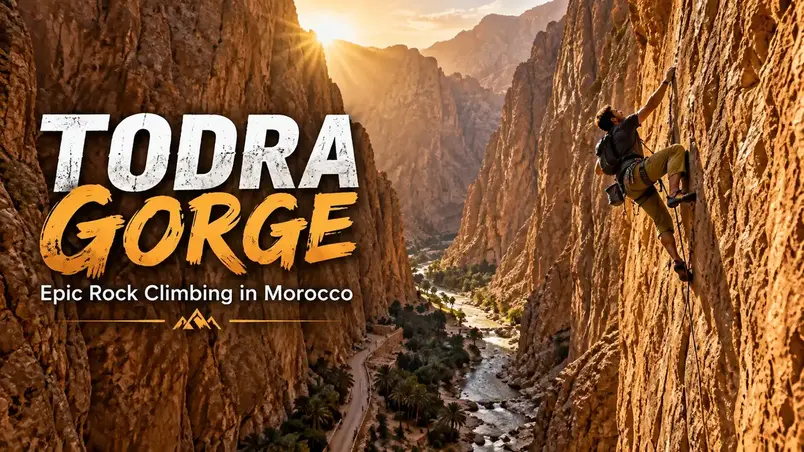
Towering limestone walls rise above a narrow river valley, sunlight moves slowly across the canyon, and the sound of water mixes with voices from nearby cafés and villages.
This is Todra Gorge, one of the most dramatic landscapes in the High Atlas and one of Morocco’s best known destinations for rock climbing.
The gorge attracts experienced climbers, beginners traveling with guides, photographers, hikers, and road trippers heading toward the Sahara. Some come specifically for the rock. Others discover Todra while traveling between Marrakech, the Dadès Valley, Tinghir, and Merzouga.
What makes the area special is that climbing is only part of the experience.
Palm groves stretch along the valley below the cliffs. Traditional villages sit against the mountains. Tinghir provides a lively base nearby, while the gorge itself offers a quieter atmosphere once the day visitors leave.
If you are planning rock climbing in Todra Gorge in 2026, this guide covers the main climbing areas, the best seasons to visit, where to stay, what to expect, and the practical safety considerations worth knowing before your trip.
(you can check this website for more Climb Morocco)
I)Todra Gorge at a Glance
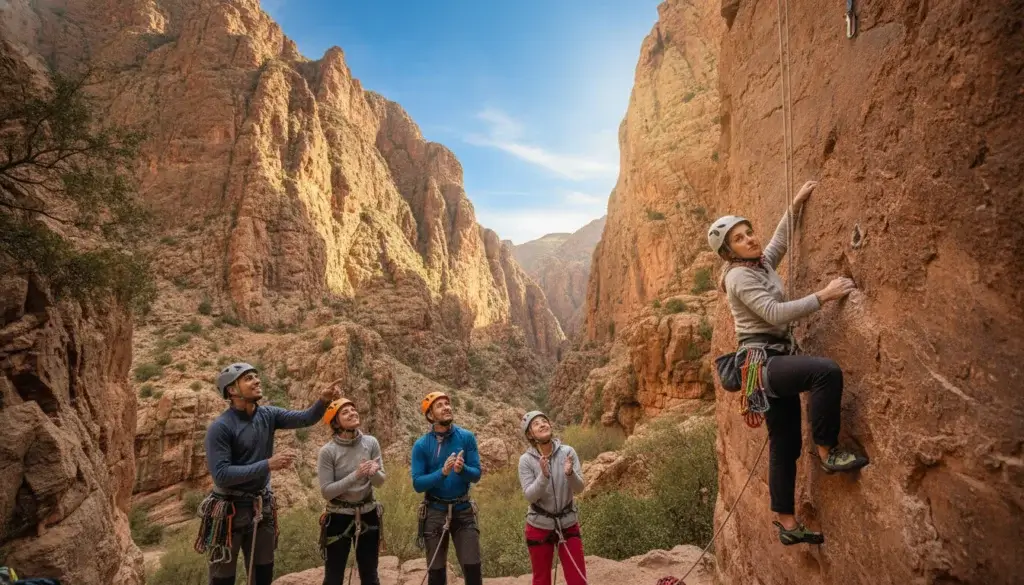
| Location | Near Tinghir in southeastern Morocco |
| Mountain range | Eastern High Atlas |
| Known for | Limestone cliffs, rock climbing, hiking, photography and canyon scenery |
| Maximum cliff height | Around 300 metres in some areas |
| Nearest main town | Tinghir |
| Distance from Tinghir | Around 15 kilometres |
| Typical climbing style | Limestone sport climbing with single pitch and longer routes |
| Grading system | French climbing grades |
| Best seasons | Spring and autumn |
| Also written as | Todra Gorge or Todgha Gorge |
II)Why Todra Gorge Is One of Morocco’s Great Climbing Destinations
The scale of Todra is the first thing you notice.
At its narrowest points, enormous limestone walls rise almost vertically beside the road and river. The canyon can feel surprisingly intimate from the ground even though the cliffs tower hundreds of metres above you.
For climbers, the attraction comes from the combination of rock quality, variety and setting.
The wider Todra area includes numerous climbing sectors with routes suitable for different levels of experience. Some areas offer shorter climbs that work well for getting familiar with the local limestone, while the larger walls attract climbers looking for longer and more demanding days.
The environment adds another dimension.
Unlike a climbing area completely isolated from local life, Todra sits within an inhabited valley. Guesthouses, cafés, villages, farms and palm groves are part of the experience.
You can spend the morning among the canyon walls, return to a guesthouse for Moroccan food, and watch the evening light move across the cliffs from the valley.
That mixture of adventure and culture is a large part of what makes Todra memorable.
III)The Landscape and Geology of Todra Gorge
Todra Gorge was carved through limestone by the Todra River over a very long period of geological change.
The result is a dramatic canyon where reddish and orange rock towers above a surprisingly green valley.
From a distance, the walls appear smooth and almost solid. Once you stand beneath them, details begin to emerge. Cracks, pockets, ledges, small edges and darker streaks create complex textures across the limestone.
The appearance of the canyon also changes throughout the day.
Morning light can illuminate one wall while leaving the opposite side in shadow. Around midday, the canyon becomes brighter and more intense. Toward sunset, the rock takes on deeper orange and golden tones.
For photographers as well as climbers, the changing light is one of Todra’s greatest attractions.
IV) Where Is Todra Gorge?
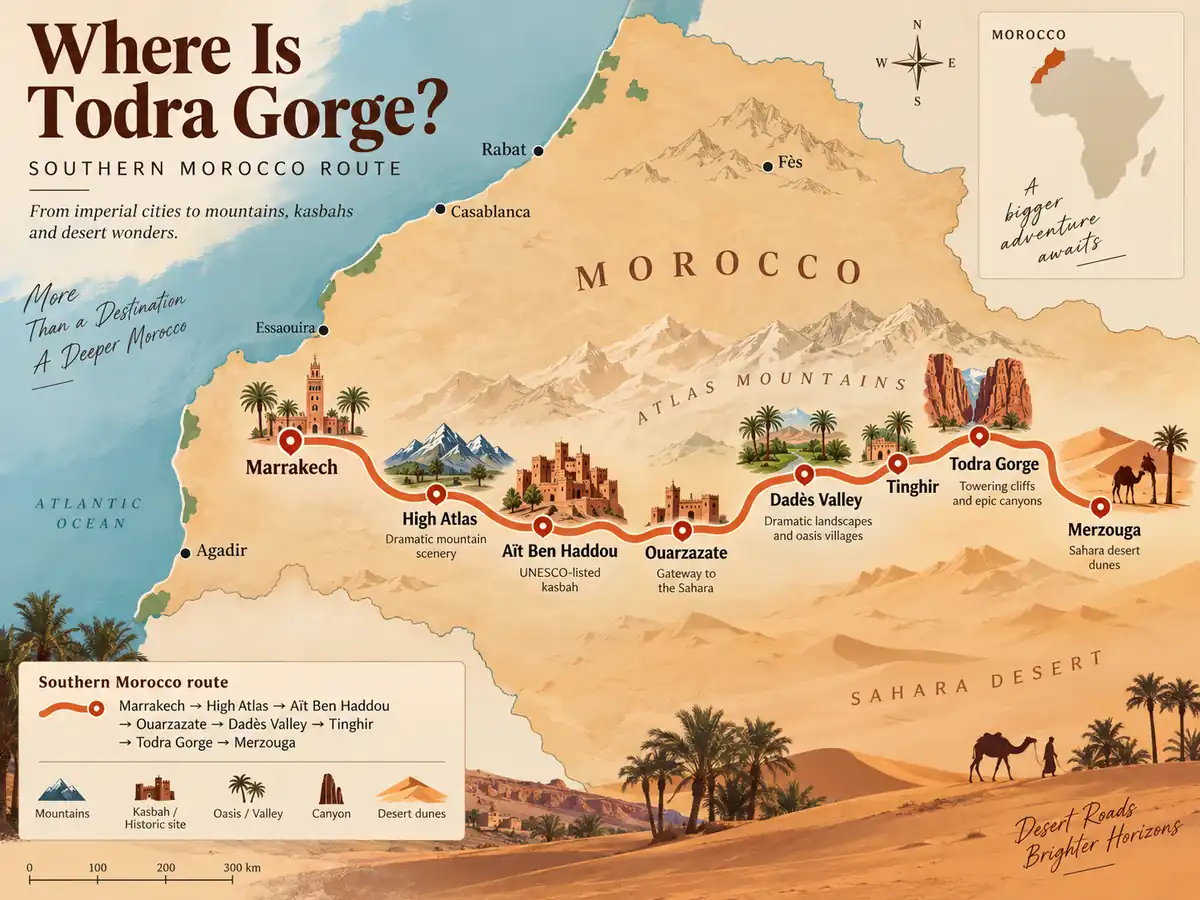
Todra Gorge lies north of Tinghir in Morocco’s Drâa Tafilalet region.
It fits naturally into one of the country’s classic southern road trips.
A popular route through the region connects:
Marrakech → High Atlas → Aït Ben Haddou → Ouarzazate → Dadès Valley → Tinghir → Todra Gorge → Merzouga
This makes Todra easy to combine with both mountain scenery and a Sahara itinerary.
V) Reaching Todra Gorge
Most travelers first arrive in Tinghir.
From there, the road follows the Todra Valley north toward the gorge. The journey itself is worth taking slowly because the landscape changes from town streets to green palm groves, traditional villages and finally the towering canyon.
| Starting Point | Approximate Travel Approach | Best For |
|---|---|---|
| Tinghir | Taxi, local transfer or rental car | Short visits and independent travelers |
| Dadès Valley | Road trip through southeastern Morocco | Combining both famous gorges |
| Ouarzazate | Drive east through the valley routes | Longer southern Morocco itineraries |
| Marrakech | Multi day road trip | Travelers exploring the High Atlas and Sahara |
| Merzouga | Drive west toward Tinghir | Travelers returning from the desert |
A rental car gives you the most flexibility, especially if you want to explore the palm groves, villages and viewpoints around Tinghir.
What Is Rock Climbing in Todra Gorge Like?
Todra is mainly known for limestone climbing.
The wider climbing area contains a mixture of shorter climbs and much larger walls. The French grading system is commonly used, so visitors coming from countries with different systems may see unfamiliar numbers and letters when looking at local climbing information.
The important thing is not simply the grade.
Conditions, route length, weather, fixed equipment and familiarity with the area all influence how demanding a climb may feel.
Anyone without strong outdoor climbing experience should consider going with a qualified local professional who knows the current condition of the climbing areas.
Todra is a destination to respect rather than underestimate.
Best Climbing Areas in Todra Gorge
Different parts of Todra suit different types of climbing days.
The following areas are among those commonly associated with the gorge and can help visitors understand the variety available.
Sector Plage
Sector Plage is one of the better known areas for visitors getting familiar with Todra.
Its relatively convenient location and selection of more approachable routes make it a common starting point for climbers who want to understand the local limestone before exploring larger walls.
For first time visitors, it can also provide a useful introduction to how Todra climbing feels compared with indoor walls or climbing areas in other countries.
Petit Canyon
Petit Canyon offers another part of the Todra climbing landscape.
It can appeal to climbers looking to spend time on shorter routes before considering the larger walls of the main gorge.
Because conditions and route information can change, it is worth asking locally about current access before choosing a sector.
Main Gorge
The main gorge provides the scenery most people associate with Todra.
Here, huge limestone walls rise directly above the canyon floor, creating the dramatic scale that has made the destination internationally recognizable.
The larger walls are primarily of interest to experienced climbers who are comfortable in a major outdoor climbing environment.
Pillier du Couchant
Pillier du Couchant is one of the names frequently associated with longer climbing in Todra.
It represents the side of the destination that appeals to experienced climbers searching for bigger walls, longer days and dramatic views across the valley.
For this type of climbing, current local information and professional judgment become particularly important.
Quick Comparison
| Area | General Character | Best Suited To |
|---|---|---|
| Sector Plage | Accessible climbing area with a range of shorter routes | Visitors getting familiar with Todra |
| Petit Canyon | Smaller climbing environment outside the biggest walls | Intermediate exploration |
| Main Gorge | Towering limestone walls and dramatic canyon scenery | Experienced outdoor climbers |
| Pillier du Couchant | Larger climbing objective | Experienced climbers |
Is Todra Gorge Suitable for Beginners?
It can be, with the right approach.
Todra is not exclusively an expert climbing destination. The wider area contains routes across a broad range of difficulty levels.
However, outdoor climbing in a mountain canyon is very different from climbing in a gym.
Weather, route finding, falling rock, changing conditions and equipment all introduce factors that beginners may not have encountered before.
Travelers who are new to outdoor climbing are better served by booking a supervised experience with a qualified guide rather than trying to learn from an online article.
That allows you to enjoy the landscape while receiving advice that reflects actual conditions on the day.
Understanding Climbing Grades in Todra Gorge
Todra generally uses the French grading system.
It combines numbers and letters, with difficulty increasing as the grades rise.
| French Grade Range | General Level |
|---|---|
| 4a to 5b | Easier routes |
| 5c to 6b | Intermediate |
| 6c to 7b | Advanced |
| 7c and above | Highly demanding |
These categories are only a broad reference.
A grade does not tell you everything about a climb. Rock condition, exposure, route length, weather and individual experience all matter.
Travelers should use current local route information rather than choosing an objective based only on a number.
Best Time for Rock Climbing in Todra Gorge
Spring and autumn are generally the most comfortable periods for visiting Todra Gorge.
The temperatures tend to be more manageable than during the hottest part of summer, while conditions are usually more pleasant for exploring the surrounding valley.
Spring
March, April and May are popular months.
The valley can be beautifully green, mornings are often comfortable and the heat is usually less intense than later in the year.
Spring is also a good time to combine Todra with a longer road trip through southern Morocco.
Summer
June, July and August can become extremely hot.
Todra’s high walls create shade in some areas, but that should not make travelers underestimate the heat.
For general sightseeing, mornings and later afternoons are often more pleasant.
Autumn
September, October and November are another strong period.
Temperatures usually become more comfortable after summer, making autumn attractive for travelers interested in both climbing and exploring the wider region.
Winter
December through February can bring cold mornings and nights.
Sunny daytime conditions may still be pleasant, but visitors should expect greater temperature variation.
| Season | General Conditions | Overall Experience |
|---|---|---|
| Spring | Mild to warm | Excellent |
| Summer | Hot to very hot | Challenging during the hottest periods |
| Autumn | Mild to warm | Excellent |
| Winter | Cool with cold mornings and nights | Variable but often enjoyable |
Always check the local weather shortly before visiting.
Mountain and canyon conditions can change quickly.
Staying Safe in Todra Gorge
Todra can look surprisingly accessible because a road passes directly through the canyon.
It is still a mountain environment.
Loose rock, heat, changing weather and the scale of the cliffs require good judgment.
For technical climbing, use reliable current information and consider professional local guidance, particularly if you are unfamiliar with the area.
Helmets are commonly considered important in climbing environments where falling debris or loose rock may be present.
Visitors should also pay attention to the weather.
Canyons can become dangerous during heavy rainfall, even when conditions elsewhere appear manageable.
Carry enough drinking water, protect yourself from strong sun and avoid treating remote sections of the area like an ordinary urban attraction.
If you are planning a significant excursion, letting your accommodation or guide know your plans is a sensible precaution.
Choosing a Local Climbing Guide
A local guide can make the experience easier to organize and provide useful knowledge about current conditions.
Before booking, ask about professional qualifications, experience in Todra and what the service includes.
A reputable provider should be able to clearly explain who the activity is suitable for and what previous experience is expected.
For beginners, guided climbing can also provide a safer introduction to the outdoor environment without turning the trip into an exercise in figuring everything out alone.
The goal should be to enjoy the destination with someone who understands both the climbing area and the local environment.
More Than Climbing: Exploring the Todra Valley
One of the biggest mistakes visitors make is focusing entirely on the narrow gorge.
The surrounding valley deserves time of its own.
Walk Through the Palm Grove
South of the main canyon, the Todra Valley becomes remarkably green.
Palm trees, cultivated fields and traditional villages contrast sharply with the dry mountains around them.
Walking through this area gives you a completely different view of the region.
Instead of dramatic cliffs, the experience becomes quieter and more connected to local daily life.
Explore Tinghir
Tinghir is much more than a transport stop.
The town serves as the main base for the Todra region and offers restaurants, markets, accommodation and transport connections.
It is also a good place to slow down after spending time in the canyon.
From several viewpoints around the area, the oasis stretches through the valley like a green ribbon surrounded by bare mountains.
Experience Local Amazigh Culture
The region around Tinghir and Todra forms part of Morocco’s Amazigh cultural landscape.
Traveling slowly gives visitors more opportunities to appreciate local architecture, food, agriculture and hospitality.
Respect matters.
Ask before photographing people, support local businesses when possible and remember that the villages surrounding Todra are communities, not attractions created for visitors.
Photography in Todra Gorge
Todra is extremely photogenic, but light makes a huge difference.
Early morning often brings softer conditions and fewer visitors.
Later afternoon can create warm tones on sections of the limestone as the sun drops behind the mountains.
Wide compositions are useful for showing the enormous scale of the gorge.
Including a person, vehicle or building in the frame helps viewers understand just how high the cliffs really are.
For a completely different visual style, photograph the palm groves outside the canyon.
The contrast between green vegetation, adobe colored villages and barren mountains tells a much broader story of Todra than the famous vertical walls alone.
Where to Stay Near Todra Gorge
There are three main options.
Stay in Tinghir
Tinghir offers the widest selection of services.
It works particularly well for road trippers who need shops, restaurants, fuel and easy onward connections.
Stay in the Todra Valley
For atmosphere, this may be the most rewarding choice.
Guesthouses surrounded by palms provide a peaceful setting between Tinghir and the gorge.
You can wake up overlooking the valley and still reach the canyon easily.
Stay Near the Gorge
Travelers who plan to spend most of their time around the canyon may prefer accommodation close to the gorge entrance.
This reduces travel time and makes early starts easier.
| Location | Best For | Main Advantage |
|---|---|---|
| Tinghir | Road trippers | More services and transport |
| Todra Valley | Couples and slow travelers | Scenic surroundings |
| Near the Gorge | Adventure focused travelers | Easy canyon access |
What to Eat Around Todra Gorge
Food becomes part of the experience after a long day outdoors.
Guesthouses and restaurants around Tinghir and the valley commonly serve traditional Moroccan meals such as tagines, couscous, bread, seasonal vegetables, olives and tea.
Dates are also strongly associated with Morocco’s southern oasis regions.
Rather than searching only for the most photographed restaurant, consider eating at smaller local guesthouses and family run places.
Ask what is fresh or being prepared that day.
A simple tagine eaten slowly on a terrace overlooking the palm groves can be one of the most memorable parts of a Todra trip.
Todra Gorge vs Dadès Gorge
Todra and Dadès are often included on the same southern Morocco itinerary, but they offer very different experiences.
| Todra Gorge | Dadès Gorge | |
|---|---|---|
| Landscape | Narrow limestone canyon | Broad valley with unusual rock formations |
| Best known for | Climbing and towering canyon walls | Scenic road and panoramic viewpoints |
| Main base | Tinghir | Boumalne Dadès |
| Photography | Vertical cliffs and palm oasis | Winding roads and geological formations |
| Ideal travel style | Walking, climbing and slow exploration | Scenic road trip |
| Worth combining? | Yes | Yes |
You do not need to choose between them.
Combining Todra and Dadès creates a much richer journey through southeastern Morocco.
How Long Should You Spend in Todra Gorge?
Many organized tours visit Todra for only a short stop.
That is enough to see the narrowest part of the canyon, but not enough to understand the destination.
One night allows you to experience the area after most day visitors leave.
Two nights are even better if you want to explore Tinghir, walk through the oasis or spend meaningful time around the climbing areas.
Travelers focused heavily on climbing may naturally stay longer.
Is Todra Gorge Worth Visiting If You Do Not Climb?
Absolutely.
Rock climbing may have given Todra an international reputation, but the canyon appeals to a much wider range of travelers.
You can walk through the gorge, explore the surrounding palm groves, photograph the mountains, visit Tinghir, enjoy local food and use the destination as a scenic stop between the High Atlas and Sahara.
For many visitors, simply standing beneath the enormous canyon walls is enough to justify the journey.
Responsible Travel in Todra Gorge
Todra is a natural attraction, an adventure destination and a living valley.
Travelers can help protect the area with a few simple choices.
Use local guesthouses, restaurants and guides when possible.
Take your rubbish with you.
Avoid disturbing agricultural land or entering private property.
Ask before photographing residents.
Respect local customs in villages.
Keep noise low around homes and religious spaces.
Follow local advice about weather, access and changing conditions.
Small decisions make a noticeable difference when thousands of people visit the same environment every year.
Planning Todra as Part of a Morocco Road Trip
Todra fits beautifully into a longer journey through southern Morocco.
One of the most rewarding routes connects Marrakech with the High Atlas, Ouarzazate, Dadès Valley, Tinghir, Todra Gorge and the Sahara around Merzouga.
This route gradually changes from mountain passes to kasbah country, then oasis valleys and finally desert landscapes.
Instead of treating Todra as a single roadside attraction, give yourself enough time to understand how it connects with the wider geography of southern Morocco.
That is when the journey starts to feel less like a checklist and more like an adventure.
Final Thoughts
Rock climbing in Todra Gorge is only one part of what makes this corner of Morocco worth visiting.
The limestone walls are spectacular, but so are the palm groves beneath them, the villages spread through the valley and the transition from mountain scenery toward the Sahara.
Climbers will find a destination with a strong international reputation and an extraordinary natural setting.
Non climbers will find one of Morocco’s most impressive canyon landscapes.
The best way to experience Todra is not to rush it.
Arrive early. Walk through the valley. Spend time in Tinghir. Watch the light change across the cliffs. Eat locally. Talk to people who live here.
And if climbing is part of your trip, combine that sense of adventure with respect for the mountain environment and reliable local guidance.
Todra is impressive from the road.
It becomes far more memorable once you stay long enough to explore beyond it.
Frequently Asked Questions
Is Todra Gorge good for rock climbing?
Yes. Todra Gorge is one of Morocco’s best known rock climbing destinations. The wider area offers limestone climbing across different levels of difficulty, including shorter routes and larger walls.
Where is Todra Gorge?
Todra Gorge is located near Tinghir in southeastern Morocco, on the eastern side of the High Atlas Mountains.
How high are the cliffs in Todra Gorge?
Some sections of the gorge rise to around 300 metres, creating the dramatic vertical landscape Todra is famous for.
What is the best time to visit Todra Gorge?
Spring and autumn are generally the most comfortable seasons. March through May and September through November usually offer more pleasant conditions than the hottest summer months.
Can beginners climb in Todra Gorge?
The wider area includes climbing suitable for different experience levels. Beginners should consider climbing with a qualified guide who understands local conditions.
What climbing grading system is used in Todra Gorge?
The French grading system is commonly used.
Do you need to be a climber to visit Todra Gorge?
No. Todra is also an excellent destination for hiking, photography, road trips, cultural experiences and exploring the surrounding oasis.
Should I stay in Tinghir or near the gorge?
Tinghir is best for convenience and services. The Todra Valley offers more atmosphere, while accommodation close to the gorge works well for travelers who want easy canyon access.
Can I visit Todra Gorge and Dadès Gorge on the same trip?
Yes. The two destinations work very well together and offer different landscapes. Todra is known for its narrow limestone canyon, while Dadès is famous for its scenic valley, winding roads and unusual geological formations.
How many days should I spend in Todra Gorge?
One night is enough for a relaxed introduction, while two nights allow time for the canyon, Tinghir and the surrounding oasis. Travelers visiting mainly for climbing may want to stay longer.