



The dynamic landscapes of North Africa are a rare opportunity to capture timeless beauty. Your camera is always at your side, whether you’re wandering through busy souks, exploring ancient medinas, or gazing across golden desert dunes.
Travel Photography in Morocco 2026 becomes more than just taking pictures—it becomes a bridge to real stories about culture, people, and everyday life. A true travel photography masterclass in Morocco requires not only technical skill, but also an open heart and a curious mind.
The first step to success in Travel Photography in Morocco 2026 is to prepare your creative mindset. You must learn how to embrace unpredictable light, shifting shadows, and the natural rhythm of local life. This all-inclusive guide to travel photography in Morocco gives you the tools you need to navigate these challenges with confidence.
Our goal is to help you build a professional-quality portfolio that remains authentic to your vision at its core. With the right approach to Travel Photography in Morocco 2026, you will be able to capture the vibrant streets, dramatic landscapes, and endless horizons that define this unforgettable destination—turning every moment into a powerful visual memory.
Morocco Travel Photography 2026: Must-Have Equipment For Your Journey
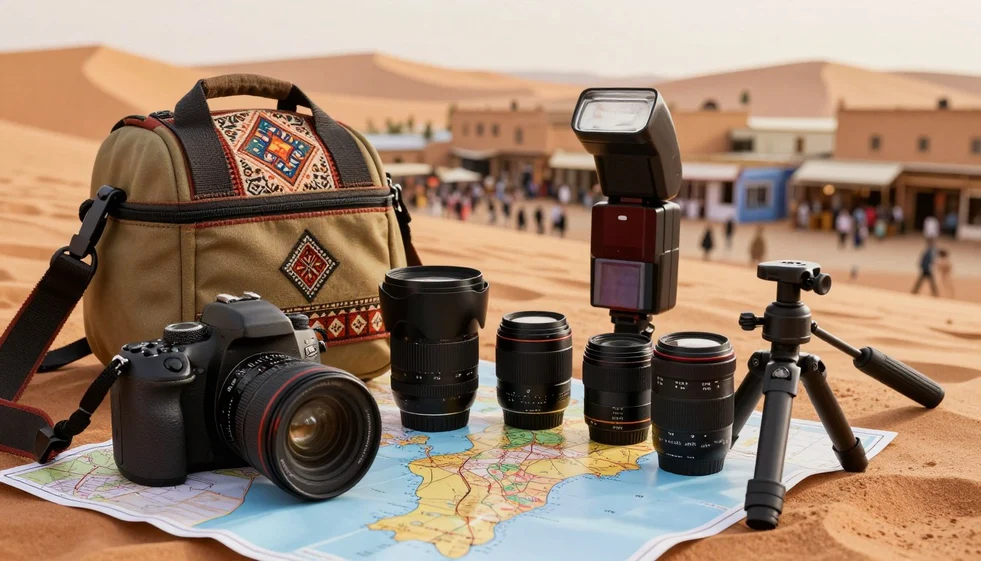
Morocco Travel Photography Gear: Cameras of Choice
Versatile equipment for Morocco. This approach allows you to capture everything, from vast deserts to tiny market scenes..
“THE BEST CAMERA IS THE ONE YOU HAVE, BUT THE RIGHT LENS IS THE ONE THAT CATCHES THE SOUL OF THE MOMENT.
Selecting the Appropriate Camera Bodies and Lenses
Mirrorless cameras are excellent for travelers. It’s high performance and portable. For the Atlas Mountains, you’ll want a wide-angle lens. For street portraits you’ll want a fast prime lens.
Flexibility is your best friend in the medinas of Morocco. A 24 to 70mm zoom lens allows you to adapt without changing lenses in dusty locations.
Protecting Your Equipment from Dust and Heat
Morocco’s climate is hard on electronics. Fine desert sand may damage your sensor. If possible, try not to change lenses in windy open areas.
A top tip for travel photography is to have a sensor cleaning kit dedicated to your camera. Batteries also run out quickly in the heat. Carry spares, stay cool.
Field Packing Basics for Long Days Out
If you’re out all day, you need a comfortable rugged camera bag. You will have quick access to your gear, and it will be safe from the crowds.
Here’s what you need to have a smooth workflow:
A light but strong tripod for stable, long exposure photography.
You’ll need memory cards to store high-resolution files.
A power bank to charge your devices while on the move.
A rain cover is also useful for blown sand.
Here are some top tips for travel photography to ensure your gear will be reliable. With the right preparation you can focus on your vision, not technical issues.
Travel Photography in Morocco 2026: Using Composition & Light
By learning composition techniques for travel photography, you can shift your perspective and approach to vibrant street scenes in Morocco. Light and geometry are important as you prepare for your travel photography in Morocco 2026 trip. They animate ancient cities. Work on these to create impactful stories out of simple scenes.
Golden Hour in the Medina
Golden hour gives you magical light for your pictures. The sun was low, casting a warm light on the old stones and wooden doors. Come early to get the best angles before the light fades.
Add depth and dimension to your shots with soft directional light. “It’s great for the peaceful side of the Medina.” “Play with light on different surfaces to create history and warmth.
Architectural Photography: The Use of Leading Lines
Moroccan architecture is full of natural geometry. Look for leading lines like arches, tiled paths, or long walls. They direct the viewer’s eye to your subject.
Use these lines to position your camera for a balanced and professional composition. Feel free to go high or low to emphasize these patterns. It simplifies complex scenes into a simple story.
Tips on Framing Narrow Alleyways
A narrow alleyway is a challenge but also an opportunity for creative framing. Frame your subject naturally with doorways, archways, or textiles. This adds a mystery and invites the viewer to go further.
With these composition techniques, your travel photography will become compelling art. Emphasize the foreground-background relationship to give a sense of scale. In Morocco, every alley is filled with stories waiting for the perfect shot.
Best Places to Take Photos in Morocco
You will go round Morocco to spectacular places. There will be a lot of rich textures and bright colors to look at. This country has everything for everyone, from quiet villages to busy cities.
Chefchaouen: The Blue Walls
Chefchaouen, a town in the Rif Mountains, is well known for its blue-painted buildings. Its softness and diffusion of light make it perfect for portraits and street shots. It is a favorite calling place for the blue-loving photographer.
The Souks of Marrakech—Colorful.
The souks of Marrakech are a riot of color. You’ll see everything from metalwork to spices. Timing is everything here. Come early to beat the crowds and get the best light.
The Ancient Kasbahs of the Atlas Mountains
The dramatic backdrop of the Atlas Mountains. These old buildings are a tribute to tradition and resilience. Architectural-minded photographers must investigate them.
Moroccan Culture and Portrait Photography
You need more than a camera to photograph Morocco. You need to connect with the local community. It’s all about the portraits in travel photos, sharing the soulful stories from the smile and face of every person.
With empathy and patience, your photos turn into powerful stories. They are more than pictures.
Respect and Asking Permission when Approaching Locals
Great portraits are about building rapport. Greet people with a smile or say, “Salam Alaikum.” Respect personal boundaries. It’s a very important part of building trust and making your subjects comfortable.
‘THE BEST PORTRAITS ARE NOT MADE; THEY ARE GIVEN. WHEN YOU BECOME CLOSE TO A PERSON, THE CAMERA DISAPPEARS.
If you don’t speak the local language, always ask for permission with a polite gesture. If someone says no, take it and move on. This makes your work ethical and genuine.
Documentation of traditional craftsmanship
There are so many good artisans in Morocco, from tile makers to leather tanners. Learn to watch without stopping to do their work justice. Patience is your biggest asset when it comes to capturing the skilled movements of artisans.
Put the camera in silent shutter mode so as not to disturb the artisan.
Look at the details: hands that are calloused, the tools of the trade.
Seek natural light sources that emphasize the texture of the materials.
Street Photography in Busy Marketplaces
The souks are busy and great for your shots, but you need to be fast. Camouflage and watch the natural flow of things rather than stop people. Expectation is everything in these crowded places.
Stand near something of interest and wait for the perfect moment. Awareness will help you tap the raw energy of daily life. More often than not, the best images happen when you are just a silent observer.
### Discovering Morocco’s Landscapes and Desert Locations
Your Morocco travel will take you to the vast deserts and high mountains. This change is a great opportunity for the photography of Moroccan landscapes. It’s hard to describe the enormous scale of these places.
There is a lot to learn, and it takes patience to learn how light plays on the land.
Sahara Dunes Sunrise Image
The Sahara Desert is a magic-hour sunrise. The early light throws deep dramatic shadows on the sand. This is the time to show off the sand’s details.
Pay attention to the ridges and ripples of the sand to add depth to your images. Use a tripod for sharp shots. The early morning light will give your photos a warm glow.
High Atlas Mountains: Capturing Contrast
Moving from the desert to the High Atlas Mountains is a new challenge. You will see snow on the peaks and dry valleys below. It’s all about the right exposure.
Hold back the sky with a graduated neutral density filter, blowing out the shadows. If the clouds roll over the peaks, patience is your best tool. They bring scale and movement to your pictures.
Dealing with Wide-Angle Shots in Large Venues
It can be difficult to convey the size of the Moroccan wilderness. Add something to your shot for a sense of scale, such as a guide or a building. It will give the viewer a sense of just how massive the landscape is.
When shooting wide-angle, be sure your horizon is straight. Add plants or rocks in the foreground to lead the eye of the viewer. Practice, and you will be surprised how great the size of these places is in your photos.
Technical Setup: Difficult Moroccan Light
To really get the spirit of Morocco, you have to learn to deal with the strong Moroccan sun. The light is often bright, creating extreme contrast. This can saturate your camera sensor.
By adjusting your exposure settings you can retain important details in the deepest shadows and brightest highlights.
Handling High-Contrast Shadows on Narrow Streets
Winding through the alleyways of the medina, you will experience sudden changes from sun to shade. Use spot metering to expose for the highlights. This prevents the blow-out. Then, in editing, recover the shadow detail.
This workflow is based on shooting in RAW format. It’s a maximum dynamic range needed to balance these high-contrast scenes well. Don’t be afraid to underexpose a little to protect the highlights.
Filters for Controlling Harsh Sunlight
Midday desert light can be flat and unflattering. A circular polarizer is a must-have tool in your kit. It cuts glare and deepens the blue of the sky. This simple addition controls reflections on stone and on glass.
If you want to shoot portraits or creative effects at a wider aperture, a neutral density (ND) filter might be something to consider. This accessory reduces the amount of light entering your lens without changing the color. But it’s also a way of keeping creative control in the middle of the day when the sun is high in the sky.
Desert White Balance Settings for Warmth
The Sahara is known for its golden color, but your camera’s auto white balance may try to fix it. To get photos that show the real warmth of the place, try setting your white balance to “Cloudy” or “Shade.” This tiny change will make the golden color of the sand and buildings stand out.
You can also shoot with a custom Kelvin setting between 6000K and 7000K. This is a very efficient method for photography to capture the spirit of Morocco. It makes your desert shots look vibrant and authentic. Always check your histogram to make sure your colors are balanced and true to the scene.
10. Photography & Ethical Considerations
Your approach to photography is essential when you are wandering around the busy streets of Morocco. Being aware is the number one tip for travel photography. This way your images will reflect the true spirit of the country.
Respect for local culture and privacy:
Morocco is a place where the value of privacy is ingrained in a long cultural and religious history. Be aware of your surroundings. This is particularly important when you are close to mosques or private homes.
Modesty is a big thing here. Think about if your presence is disturbing someone. A responsible traveler is a respectful traveler.
Do Not Engage in Exploitative Photography Practices
Concentrate on telling real stories, not merely taking pictures. Don’t use local people as props for your photographs. Always ask permission before photographing people in difficult situations.
Think of the people you photograph as collaborators, not just subjects. This will make your photos more meaningful. This is a great travel photography tip.
Establishing Rapport Before the Shot
• Talk to the locals before taking photos. It makes a huge difference. A simple hello or smile can go a long way. It makes everyone feel respected.”
If you’re unsure, ask first. Respect someone’s ‘no’. These pointers will make for a positive experience for all.
Post-processing techniques for a better Moroccan portfolio
The final step to perfect your vision is photo editing in Morocco. Your fieldwork captures the raw emotion of the landscape. Post-processing allows you to fine-tune those details and breathe your own vision into life. Taking the time on your digital workflow ensures that every image reflects the true beauty of your travel.
Warmth and Vibrance Color Grading
Moroccan architecture is also rich in earthy tones and vibrant tile work. When editing photos from Morocco, make these colors pop. You can gently bump up the saturation for oranges and yellows to show the heat of the desert sun.
Don’t over-process your files. You want it to sound natural. Small tweaks to the white balance can also help in capturing that iconic golden glow of old medinas. This adds a sense of warmth, welcome, and authenticity to your portfolio.
Lens Distortion Correction for Architectural Images
Wide-angle lenses are needed to capture the majesty of the ancient kasbahs, but they tend to introduce distortion. Use your software’s lens correction tools to correct vertical lines and make sure your architectural shots are geometrically sound. This simple step makes a huge difference to the professional quality of your work.
When the lines are dead straight, the eye of the viewer can concentrate on the details of the masonry. Precision is the name of the game in recording historic buildings. Fixing these minor imperfections can take your photography from a mere snapshot to a work of art.
Dynamic Range Management in High-Contrast Scenes
The bright North African sun creates deep shadows and hard highlights that can be challenging to control. The dynamic range means that when you are editing photos from Morocco, you will have to learn how to work with this to bring out hidden detail. Pull the shadow and highlight sliders in your software to reveal texture in dark alleyways or sun-soaked walls.
If you are shooting in RAW, you will have a lot more leeway to pull back information from these extreme areas. If a single file cannot capture the full range of light, don’t be afraid to experiment with exposure blending. Once you have gotten the hang of these technical tweaks, you will have the confidence to shoot in any lighting condition on your future trips.
Your journey to North Africa begins with a single photo. It is your foundation for capturing the rich colors and textures of this historic land.
Success in photography is a combination of technical skill and a sense of awe. Complex lighting and cultural details are easy to handle. Trust your instinct when you explore markets or mountain trails.
Every shot is a story of people and nature. Get ready to capture those moments that show the way you see the world. This guide will help you turn your simple moments into a professional collection.
Share your best photos with others and inspire them to see these ancient places. Your vision brings the Sahara and the Atlas Mountains to life for everyone. Get ready for a spectacular journey in 2026.
Read: Ultimate Street Photography in Morocco
Resources:
- Weather conditions and light planning:
Windy weather forecast tool
Use this for tracking golden hour conditions, wind, and desert visibility. - General Morocco travel planning and locations:
Visit Morocco official tourism board
Great for discovering cities, cultural spots, and seasonal travel tips. - Travel safety, routes, and inspiration:
Lonely Planet Morocco guide
Useful for itinerary planning and photography location ideas. - Photography inspiration and gear research:
National Geographic Travel
Ideal for composition ideas and storytelling techniques.